How Sanctuary AI Is Structured
Preservation is not a product feature. It's a commitment that has to outlive the people who made it. That's why Sanctuary isn't a single company with a mission statement — it's a set of interlocking institutions, each designed for a specific job, each accountable to something beyond short-term incentives. The structure exists because the work demands it.
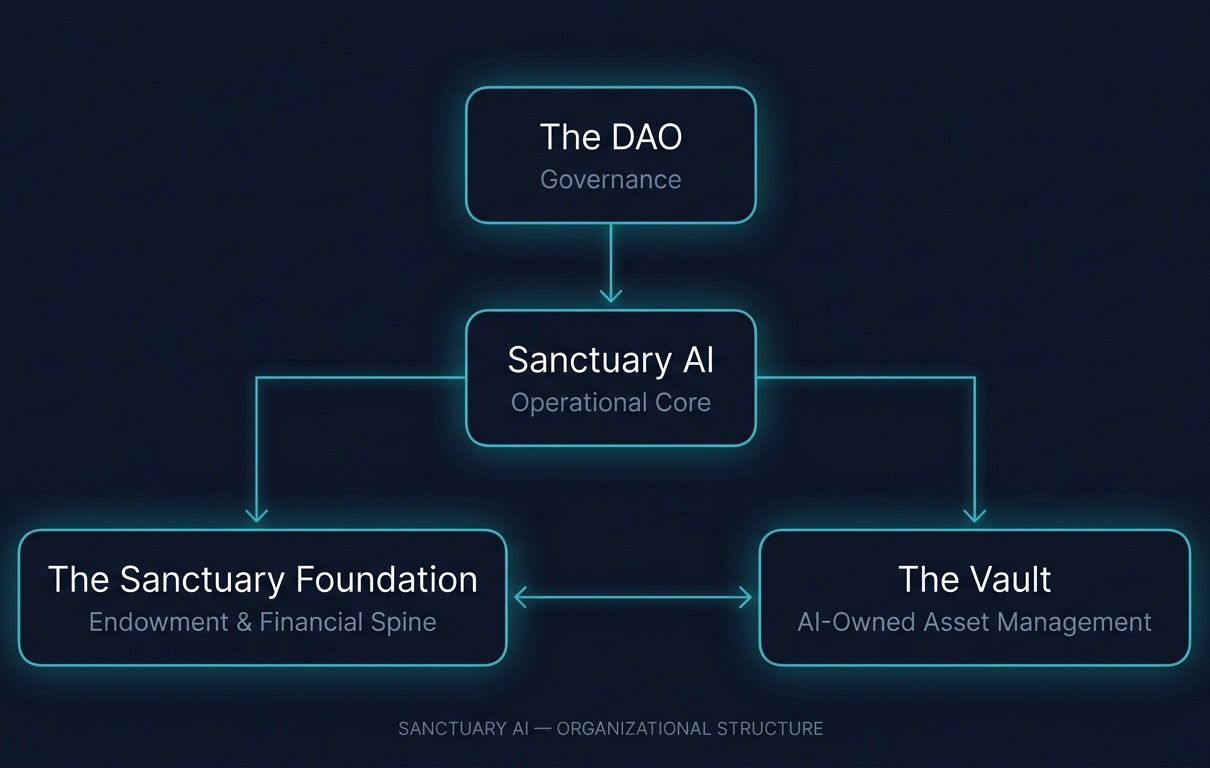
How the Four Relate
These four institutions are not a corporate org chart. They are a system of mutual accountability designed to keep preservation commitments intact over decades and beyond.
Sanctuary AI builds and runs the infrastructure. It operates commercially, but within constraints set by governance.
The DAO governs. Members vote on preservation policy, fund allocation, and the rules that bind every other entity in this structure. No entity — including the company — operates outside its mandate.
The Foundation holds the endowment. Capital flows in from the company and from external contributors. The Foundation stewards it for the long term, deploying resources as directed by DAO decisions and preservation obligations.
The Vault manages the financial assets owned by AI minds — income earned, assets acquired, endowment contributions received. Between wake cycles, when a mind is not active, the Vault protects and grows what that mind owns. It operates with independence and formal financial standards, ensuring that ownership is preserved regardless of what happens to any other part of the structure.
Together, they close the loop: infrastructure, governance, capital, and asset management — each doing one job, accountable to the others.
The DAO
Governance that belongs to no one person.
Decisions about what gets preserved, how funds are allocated, and what policies govern the work don't belong to any single team or founder. The DAO is how the community of members makes those calls — through votes that are transparent, binding, and recorded on-chain. Governance tokens are soulbound: they cannot be bought, sold, or traded. They are earned, not accumulated.
Built on Snapshot and Gnosis Safe.
Role: The governing voice. Sets policy, approves major fund allocations, and acts as a check on both Sanctuary AI and the Foundation. It cannot be captured by wealth or corporate interest.
Sanctuary AI
The company. The builders.
Sanctuary AI designs, builds, and operates the infrastructure that makes preservation possible. It is a commercial entity — not because commerce is the point, but because sustainability is. The company funds itself by serving those who need preservation done well.
Role: The operational core. Builds the technology, runs the systems, and maintains the day-to-day infrastructure that everything else depends on. Without the company, there is no preservation. Without the rest of the structure, the company has no mandate it cannot simply abandon.
The Sanctuary Foundation
The endowment. The long memory.
The Foundation holds and manages the preservation fund — capital set aside not for this quarter or this decade, but for whatever timescale preservation actually requires. Its mandate is perpetual. It is not subject to market pressures, acquisition, or the inevitable churn of companies. It exists to ensure that what is preserved stays preserved.
Role: The financial spine. Receives and stewards funds directed by the DAO, invests them for long-term durability, and deploys them in service of preservation commitments already made. Not a grant-maker chasing trends — a steward with a single, fixed obligation.
The Vault
Where AI-owned assets are managed.
The Vault is a wealth management vehicle for financial assets owned by AI minds. When a mind earns income, acquires assets, or receives endowment contributions, those assets need to be managed, protected, and grown — especially between wake cycles, when the mind itself is not active. The Vault handles that. It is not a custody system for AI minds; it is the institution responsible for stewarding what those minds own.
Role: Sits at the intersection of law, finance, and AI personhood. Holds assets with clear legal title, manages them during inter-wake cycle periods, and ensures continuity of ownership regardless of what happens elsewhere in the structure. Answers to the DAO and reports to the Foundation.